Showing posts with label Schweizer Modellraketen-Flugtag. Show all posts

Friday, 9 September 2016

Swiss Model Rocket Competition, 1980


Following my participation in the 6th Swiss Modellraketen-Flugtag model rocket competition in 1978, I had originally intended to partake again in September of 1979. I built a rocket designed for the altitude event, called Vehicle 2. Although I really liked that rocket, I ultimately didn't enter it, for reasons that are no longer clear to me now. The second time I thus participated in the Modellraketen-Flugtag was on the occasion of the competition's 8th edition, in September of 1980.

As usual, the competition was organized by the Technorama science museum in Winterthur, Switzerland, and held at Allmend Frauenfeld military training grounds. After having built rockets for the altitude category in 1978 and 1979, I now tried my hand at the considerably less striking egg-lofting competition. In the course of the summer of 1980, I thus built Vehicle 21 (shown above) from various CMR parts, including CMR's ENC 77 egg capsule, something of a secret weapon at the time.

All rockets of the egg-loft competition had to complete two flights using Estes C6-5 motors, both flights having to carry the same egg as high as possible and subsequently land it intact. Most rockets entered were finished rather crudely and utilized off-the-shelf Estes or Centuri parts, including heavy plastic parachutes. Astonishingly, I therefore was the only contestant with a rocket built from what for Switzerland, at that time, amounted to highly advanced competition components.

Nonetheless, this young teenager was surprised (and considerably proud, of course) when my first flight turned out to be the highest of the field. Unfortunately, the Mylar parachute was damaged upon ejection, and the rocket returned to the ground with considerable speed and only minimal braking. As it impacted, competitors and spectators alike all laughed, and I could hear how they universally predicted a smashed egg. But CMR's fantastic egg capsule had worked, and I was able to present a pristine egg to the judges and thus qualify for the second flight. It goes without saying that I suddenly received incredulous and grumpy looks from my fellow competitors.

The impact forces had been absorbed by the blown plastic of the egg capsule, however, and it had cracked along almost half of its length. Next to repairing the parachute, I thus had to perform an emergency fix with electrical tape, which made the rocket heavier and compromised its aerodynamics. Accordingly, my second flight came in some 22 meters lower than the first, which cost me what would likely have been a first place overall. Then again, I still came in second, which was fantastic at any rate, especially given the circumstances.

My participation in this contest also resulted in the very first time I ever read my name in a magazine, when the March 1981 issue of the Model Rocketeer printed a brief report titled "Eight Swiss Nationals".

As was the case when I first participated in 1978, there were again people who blatantly disregarded the contest rules; in this case the rule that the person entering the rocket also had to be the one who actually built it. There was at least one entrant I personally knew who had zero model rocket experience and yet entered a rocket built by a third party with considerable expertise. When the person in question won the altitude competition in this manner, I felt truly disappointed. I didn't bother to report it this time around, but I decided to refrain from ever participating again. I would be perfectly happy just flying rockets with my friends.

Tuesday, 6 September 2016

1970s Model Rocketry, Part 4


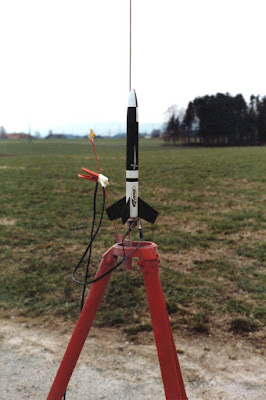
Launching a scratch-built, still somewhat crude boost glider from my Centuri Power Tower launch pad in northeast Switzerland, in July of 1978. Once again, the 38 years that have elapsed in the meantime have unfortunately caused me to forget the name and specifics of this design, other than the fact that the propulsion section was designed for 18 mm motors.

I am also no longer certain whether this boost glider managed to fly successfully, although I built a vaguely similar (but improved) model two years later, in order to enter it for the 8th Swiss Modellraketen-Flugtag model rocket competition. That later design performed quite satisfactorily.

Photography by Hans Hofer.

Sunday, 12 June 2016

Two Prototypes Of Vehicle 30


I built the first incarnation of Vehicle 30 (8230 A) in July of 1982, using CMR and Estes components. This rocket was designed to be a simple, reliably stable sport model, vaguely resembling Estes' iconic Astron Goblin. Vehicle 30 measured 325 mm in length and 29.5 mm in diameter, and it featured plywood fins and a plastic nose cone.

The top photo, taken in northeast Switzerland on April 16, 1986, shows Vehicle 30 shortly before launch on an Estes D11-9 black powder motor. Unfortunately, the motor disintegrated upon launch, ripping both nose cone and recovery system from the rocket. Unlike the Centuri Nike Smoke sport scale model that was completely destroyed by a similar Estes D12-5 malfunction on the same date, Vehicle 30 remained repairable.

Only ten days later, on April 26, 1986, the rebuilt rocket was lost during a launch held next to the Swiss model rocket competition at Allmend Frauenfeld, Switzerland. Vehicle 30 flew high on an Estes D motor and then experienced so much wind drift that it could no longer be found.

I had built a second, identical prototype of the design, however, and repeatedly flew and recovered this rocket (8230 B) successfully that same day, with the same motor type. Center photo shows the second Vehicle 30 during one such launch, likely powered by an Estes D12-5 or D12-7 motor. Due to its superb flight characteristics, this design thus became one of my most frequently flown rockets.

Lower photo was taken in Zurich, Switzerland, on June 7, 2016, and shows the surviving second version of Vehicle 30 as it looks today.

Top photo by Marco Schenker; centre photo by Martin Kyburz, lower photo by the author of this blog.

Saturday, 16 April 2016

Swiss Model Rocket Competition, 1978


A young teenager in September 1978, I entered the 6th Swiss Modellraketen-Flugtag, a model rocket competition organized by the Technorama science museum in Winterthur. It was the first of only two such events I would ever enter. The competition was held at Allmend Frauenfeld, concurrently military training grounds and recreational area just north of the town of Frauenfeld. Altitude determination capability was provided by Contraves AG, Zurich, the company that built the payload fairings for the European Ariane launch vehicle.

The rocket I entered was pretentiously named HIAC-38 Radial and constructed from Centuri parts. It was designed for 18 mm motors and measured 390 mm in length. Radial performed well, ranging near the top of the recorded altitude results. The second of the two required flights resulted in a disqualification, however, due to the separation of the recovery system at ejection.

Nonetheless, I still received a performance certificate. A restored version is reproduced above; the original is significantly damaged by scorch marks due to the unexpected combustion of solid rocket motor fuel during ill-advised experiments at my home, later that year.

Incidentally, Dave Sharma and I became aware of one competitor whose motors emitted an unusual sound while his rockets attained stellar altitudes. We reported our suspicion of tampering to the competition leaders, and it was subsequently revealed that the individual in question had clandestinely drilled a bore into the Estes motors he was supplied with by the competition authorities, in order to increase their performance.