Showing posts with label Centuri. Show all posts
Monday, 31 August 2020
United Press International Photo 1969, Part 2
A further United Press International photo from a series of images taken at an NAR launch at Goddard Space Flight Center in Greenbelt, Maryland, on November 29, 1969. The sophisticated rack launch pad shown in this beautifully detailed photo is mainly dominated by launch-ready old-school boost gliders typical for the period.
The second rocket from the left looks like an extended Estes Astron Drifter, the third model from the left appears to be an Estes Astron Falcon rocket glider.
The press text attached to the rear of the original photo reads as follows:
WAP 1613622
MODEL ROCKETRY
GREENBELT, MD: On the launching pad at the Goddard Space Flight Center here, five await their turn while a sixth model rocket is launched. Model rockets do not require concrete bunkers for safety purposes. No extensive safety precautions are needed. The rockets are launched electrically from 10 to 15 feet. Each model rocket contains a recovery device such as a parachute, streamer or other high drag mechanism. The models are returned safely to the ground so that they can be flown many, many times. Some model rockets have been sent aloft as many as 100 times.
11/29/69
Monday, 24 August 2020
United Press International Photo 1969
This beautifully evocative vintage image, taken at Goddard Space Flight Center in Greenbelt, Maryland, is a United Press International photo, dated November 29, 1969. There's a candid immediacy to the scene depicted; it conveys a familiar sincerity and enthusiasm most of those who were teenagers captivated by model rocketry during the 1960s or 1970s (such as the author of this blog) will immediately remember.
It's fun to rummage visually through the details in this picture to discover items one is familiar with. The most obvious being the rockets, of course, such as the main body, clear payload section, and nose cone of a Centuri Payloader II in the grass, the Estes Astron Camroc camera nose cone in the boy's hand, or the Centuri (or Estes?) Apollo Little Joe II in the cardboard box at right. Next to the boy's left foot is a Centuri 1967 model rocketry products catalog, quite a collector's item today, all these years later.
The press text attached to the rear of the original photo reads as follows:
WAP 1613620
MODEL ROCKETRY
GREENBELT, MD: With the equipment and tools necessary to build a model rocket, a member of the National Association of Rocketry is busy assembling his latest creation. Each year, the NAR sanctions contests throughout the United States in preparation for the National Model Rocket championships, also sanctioned by the NAR. Model rockets are constructed of paper, balsa wood, and breakable plastics and contain no substantial metal parts. The rockets are powered by commercially manufactured propellants of proven reliability and performance.
11/29/69
Wednesday, 7 June 2017
Astron Alpha Recovery
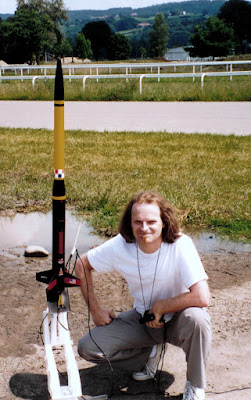
The fourteen year old me holding my freshly recovered Estes Astron Alpha after the launch seen elsewhere on this blog. This particular model was an early-style Alpha, featuring balsa wood fins and nose cone.
As noted in the aforementioned earlier post, this rocket was likely a self-made clone, as evidenced by what seems to be a Centuri parachute. I built a number of Astron Alphas of all incarnations, both from official Estes kits and as self-made replicas. It soon became a tradition to initiate launches with an Alpha, in order to determine wind conditions before switching to larger models.
Photographed by Hans Hofer in northeast Switzerland, in July 1978.
Labels:
Astron Alpha
,
Centuri
,
Estes
Tuesday, 30 May 2017
Enerjet 1340/20
In my posts on this blog, I frequently alluded to how mythical Enerjet and that company's products appeared to us teenagers in mid-1970s Switzerland. At the same time, it was often difficult for us to find sufficient and reliable information about developments in our field of interest. We had to rely on issues of Model Rocketeer magazine, sporadic glimpses offered in company periodicals such as the Rocket Times or Model Rocket News. Or we deducted as much as we could from photos and text published in G. Harry Stine's Handbook Of Model Rocketry or Centuri's Model Rocket Design Manual, among others.
Congruent with our increasing skill in building and flying model rockets, we coveted any possibility to accomplish more advanced concepts and obtain motors with increased power. In the second half of the 1970s, when we became increasingly immersed in rocketry, Enerjet no longer existed, and it is very doubtful if any of Enerjet's products ever even made it to Switzerland while the company traded. We eventually found some solace when it became possible to obtain Flight Systems' products through a distributor in Germany, and we duly moved up a notch, both in motor power and materials.
But one of the rockets that always exerted an iconic radiance on me was Enerjet's 1340/20 payload rocket, first seen by us on page 231 of the fourth edition of the Handbook Of Model Rocketry, in 1976. Although I knew next to nothing about this rocket at the time, it became one of those designs that has never ceased to fascinate me in the 41 years since.
After Enerjet's demise, parent company Centuri continued to offer a number of components that were part of some of the former's most notable rockets. Among them were the #13 plastic fin unit (prod. no. F-413L), used by Enerjet's 1340 and 1340/20 designs and later part of Centuri's Phoenix Bird and Argos "Kwik Kits". Or the transition section and nose cone of the payload section of Enerjet's 1340/20, later offered in the guise of an egg capsule (prod. no. PNC-13E/ST-202), for example in Centuri's Rocket Times in fall of 1975 (a supplement to Centuri catalogue no. 761). And following the merger of Centuri and Estes, these parts occasionally reappeared as part of Estes kits, such as the Eliminator (the fin unit) or Eggspress (payload section).
Nonetheless, obtaining these parts to construct an Enerjet 1340/20 replica in the present day proved somewhat challenging, in spite of their sporadic availability and modern procurement tools such as the internet and eBay. Another surprise was the material used for the 1340/20's transition section and nose cone in their most recent guise as the egg capsule of the Eggspress. Instead of the more common, glueable high-impact styrene used for most nose cones, the plastic used for these parts is reminiscent of cheap garden toys for children, as usually imported from Asia, i.e., polyethylene. This flexible plastic is difficult to sand (and sanding is unavoidable due to the age of the original moulds), glue, and paint. I suppose this material was chosen due to its ability to absorb impacts without cracking.
The styrene plastic fin unit, on the other hand, appears to be entirely unchanged from the one I owned as part of my Centuri Phoenix Bird in 1978. The only difference is the colour in which it is moulded. As I was beginning to run low on original Enerjet waterslide decals, I had Wessex Transfers in Australia print me some replica decals.
Enerjet logo and Enerjet 1340/20 brochure sample page © by Enerjet Inc., Phoenix/AZ, USA.
Labels:
Centuri
,
Enerjet
,
Enerjet 1340
,
Enerjet 1340/20
,
Estes
,
Flight Systems Inc.
,
G. Harry Stine
,
Handbook Of Model Rocketry
,
Model Rocket Design Manual
,
Model Rocketeer magazine
,
Phoenix Bird
,
Rocket Times
Monday, 17 October 2016
1972 Enerjet Catalogue
Sample pages from the unique and intriguing 1972 Enerjet advanced rocketry model products catalogue (no. 721).
As deeply curious and utterly determined teenagers building model rockets in remote (from a consumer point of view) Switzerland in the mid to late 1970s, we were continuously driven towards increasingly advanced rocket concepts and the quest for rocket motors more powerful than the commonly available A, B, C, and D-class motors. Mind you, it was far from granted to find even such "regular" motors in Switzerland at the time. Our ambitions were satisfied to some extent when a German distributor brought the product line of Flight Systems Inc. to our hemisphere and we were finally able to obtain their range of D, E, and F black powder motors.
In our minds, however, Enerjet represented the holy grail of advanced model rocketry, and it therefore served as the underlying inspiration for many of our own projects. This was of course long before readily available information by means of the internet, and even though Enerjet was no longer trading as an active company by that time, the company, for us, was thus an entity equally shrouded in mystery and emitting a limitless fascination. The few things we knew about Enerjet had been glanced from pictures in books (the Handbook Of Model Rocketry) and Centuri brochures, or from the remnants of Enerjet's existence as evident in Centuri's catalogues.
I would have given anything to own the 1972 Enerjet catalogue at the time (or to even be granted to have a brief look at it), but any such publications remained unobtainably elusive for us two rocket obsessed adolescents in Switzerland. Only much later in my life was I finally able to obtain a pristine original edition. The infinite waiting period mattered little; Enerjet's very existence and iconic designs still represent the same captivating inspiration to me to this very day.
The above excerpts from the 24-page catalogue show, for example, Enerjet's revolutionary "port burning" composite motors with glass fibre casing, or the fantastic (and operable) Nike Smoke semi scale rocket (vaguely similar to the Centuri kit) and Nike Ram high altitude payload rocket.
1972 Enerjet catalogue sample pages © by Enerjet Inc., Phoenix/AZ, USA, 1972, scanned from my personal copy of the catalogue.
[Entry amended October 31, 2016; with thanks to Chris Michielssen.]
Tuesday, 4 October 2016
Rocket Fleet, 1989
Scans of two regrettably very deficient analog photos taken at my former home in Nürensdorf, Switzerland, in autumn of 1989, depicting part of what was then my rocket fleet as well as some designs under construction at the time.
Top photo shows, from left: Vehicle 59, built from Flight Systems and Centuri parts and designed to fly with Flight Systems E black powder motors. Vehicle 59 measured 886 mm in length (including a payload section of 456 mm length). The rocket in the center is my scratch-built Honest John semi scale model (still lacking any finer details), while the model on the right is Vehicle 51 B Enigma II, a development of the earlier Vehicle 39 A Enigma. Vehicle 51 B was constructed using Estes, Centuri, and CMR components and intended to be flown with Flight Systems E and F motors. It measured 896 mm in length and featured a payload section of 158 mm usable space. The lower and upper sections of the rocket were recovered by means of two separate parachutes.
Lower photo, from left: Vehicle 32, a cluster design utilizing three 18 mm motors and featuring a payload section. Next to it are Vehicle 23, a 24 mm experimental design with ultra thin, high aspect-ratio plywood fins, and Vehicle 22 B, also using three high aspect-ratio plywood fins that were strengthened with an epoxy coating. The rocket line-up is completed by Vehicle 48 A Heracles (designed for 21 mm and 24 mm D motors), Vehicle 39 A Enigma, and Vehicle 44 A Rhea (a sport model with payload section, built specifically for Flight Systems D18 motors).
Labels:
Centuri
,
CMR
,
Estes
,
Flight Systems Inc.
,
Honest John
,
Vehicle 22
,
Vehicle 23
,
Vehicle 32
,
Vehicle 39
,
Vehicle 44
,
Vehicle 48
,
Vehicle 51
,
Vehicle 59
Sunday, 2 October 2016
Homage To Model Missiles, Inc.
I scratch-built this semi scale Aerojet-General Aerobee-Hi in 1986, using Centuri parts. It was an homage of sorts to the beginnings of our hobby and thus to some of the protagonists that had inspired me during my youth, ten years earlier: Orville H. Carlisle and G. Harry Stine.
As described, for example, in a fantastic article titled The First Model Rocket Kits, authored by G. Harry Stine and published on pages 5 to 9 of the February 1978 issue of Model Rocketeer magazine, Carlisle and Stine's Model Missiles, Inc. produced the Aerobee-Hi as the company's first proper model rocket kit in 1958. Moreover, I also admired the early Aerobee-Hi model rockets when I obtained what was my first copy of the Handbook Of Model Rocketry (Fourth Edition) in 1976 or 1977, such as in the formidable launch photo on page 125. We were model rocket obsessed teenagers at the time and not only glorified G. Harry Stine but also the beautifully pure design of the Aerobee-Hi rocket.
My own Aerobee-Hi was first launched on May 28, 1999, many years after I had originally completed it. The top photo shows the final preparations for this maiden flight, conducted with an Estes B6-4 motor in northeast Switzerland. As can be expected for such an immaculate design, it performed flawlessly. The lower two photos show the same rocket in May 2016, in Zurich, Switzerland.
Wednesday, 28 September 2016
Rocket Fleet, 1986
Part of my active fleet, photographed on the occasion of our morning to afternoon launch at Allmend Frauenfeld, Switzerland, on Saturday, April 26, 1986. It was a beautiful, clear day with only low wind and a temperature of 20 degrees Celsius. Incidentally, this was also the day the Chernobyl nuclear disaster took place.
Lower photo shows, from left: the black Vehicle 31 (featuring self adhesive Mylar foil on payload section), the white and black Vehicle 39 A Enigma, (flown for the first time during this launch), and the black Vehicle 28 A (with white fin and nose cone), a rocket built specifically to fly with Flight Systems E and F black powder motors. The flights of Vehicle 28 A revealed stability deficiencies which subsequently led to a redesign.
Next are the two prototypes of Vehicle 30; #8230 B is on top and #8230 A at bottom. I was about to lose the latter that day. Then the silver/black/red Vehicle 44 Rhea, a payload carrier built from CMR components. To the right of Vehicle 44 are my Estes Bandit (repaired from its previous motor failure) and my trusty Centuri Starfire. Then, the newly completed silver/white/black Vehicle 48 A Heracles (bottom) and the red/white Vehicle 36 B sport model, built from Centuri parts (top).
This is followed by the silver/white/black Vehicle 22 B payload model with its high aspect-ratio fins, my Centuri Excalibur 2, and my Estes Titan II ICBM. The line-up is completed by Vehicle 33, a delta-wing boost glider loosely inspired by Estes' legendary Astron Skydart. Vehicle 33 was scratch-built in 1981, using Flight Systems and Estes components.
In addition to all of these rockets, the top photo also shows one of my Estes Astron Alphas (far right), frequently used to open a launch and determine the wind conditions.
Photography by Martin Kyburz.
[Entry amended October 17, 2016.]
Labels:
Astron Alpha
,
Astron Skydart
,
Centuri
,
CMR
,
Estes
,
Excalibur 2
,
Flight Systems Inc.
,
Titan II ICBM
,
Vehicle 22
,
Vehicle 28
,
Vehicle 30
,
Vehicle 31
,
Vehicle 33
,
Vehicle 36
,
Vehicle 39
,
Vehicle 44
,
Vehicle 48
Tuesday, 6 September 2016
1970s Model Rocketry, Part 4
Launching a scratch-built, still somewhat crude boost glider from my Centuri Power Tower launch pad in northeast Switzerland, in July of 1978. Once again, the 38 years that have elapsed in the meantime have unfortunately caused me to forget the name and specifics of this design, other than the fact that the propulsion section was designed for 18 mm motors.
I am also no longer certain whether this boost glider managed to fly successfully, although I built a vaguely similar (but improved) model two years later, in order to enter it for the 8th Swiss Modellraketen-Flugtag model rocket competition. That later design performed quite satisfactorily.
Photography by Hans Hofer.
Wednesday, 31 August 2016
Estes Bandit Motor Failure
These are the last photos to show the only Estes Bandit I ever owned while it was still in pristine condition. They were taken in northeast Switzerland on April 16, 1986, during the same launch that saw an Estes D12-5 motor failure destroy my Centuri Nike Smoke.
When building the Bandit, I had converted it to fly on 24 mm motors, and this would turn out to be its ruin. The top photo shows pre-launch preparations; this flight was also going to use an Estes D12-5 motor, which can be seen already installed, with the Estes Solar Ignitor in place. Also of note are the Flight Systems Inc. E and F black powder motors in the range box.
The lower photo shows the Bandit on my converted theodolite metal tripod launcher, shortly before the launch button was pressed. Upon ignition, the motor disintegrated before the rocket lifted off. A single, burning motor fragment was ejected from the resulting fireball. The rocket suffered significant internal damage, but the main airframe was surprisingly still somewhat intact.
This was the second Estes D12-5 motor failure that day, and another one (a D11-9) was still to come. The damage to the Bandit was rather disappointing; its beautifully nostalgic design was among Estes' most attractive at the time, and its internal baffle system made it an intricate and unusual model.
Photography by Marco Schenker.
[Entry amended October 17, 2016.]
Labels:
Bandit
,
Centuri
,
D11-9
,
D12-5
,
Estes
,
Flight Systems Inc.
,
motor failure
,
Nike Smoke
,
Solar Ignitor
Sunday, 28 August 2016
Vehicle 65
Vehicle 65, a minimum-diameter, high-performance sport model rocket intended for 18 mm C6-7 black powder motors.
Vehicle 65 was built in April of 1999, using Centuri (PNC 76 nose cone) and Estes (BT-20 body tube and EB-20A engine block) parts as well as 1.7 mm plywood fins. The rocket measures 306 mm in length, and it is recovered by a Centuri RS-20 streamer.
Given the small size of this rocket and the altitudes attainable with it, it likely wasn't my greatest idea ever to paint it green and thus render it camouflaged after recovery.
Top photo shows Vehicle 65 shortly after completion and on an Estes Porta-Pad II launch pad in Thalwil, Switzerland; bottom photos were taken in Zurich, Switzerland, in August 2016.
Thursday, 25 August 2016
Centuri Starfire (Redux)
My Centuri Starfire, already discussed on this blog in mid-July, seen returning to earth after one of several fantastically stable and reliable fights at Allmend Frauenfeld, Switzerland, on April 26, 1986. It was a beautiful and only slightly windy day, and we flew our rockets next to the launch site chosen for a model rocket competition hosted on the same date by the Technorama science museum.
We conducted a total of 31 launches during the morning and afternoon, and without intending to do so at all, we ended up stealing the spotlight from the official competition. The competitors' rockets were required to be powered only by mini motors, while we flew anything from Estes B to Flight Systems E motors, including some rare D13-7 composite motors of eastern European manufacture - these were the days when the Iron Curtain still existed. Needless to say, we received a number of jealous glances from the organizers of the competition, as the spectators kept watching our flights rather than theirs. But such is life.
Labels:
Centuri
,
D13-7
,
Estes
,
Flight Systems Inc.
,
Starfire
,
Technorama
Friday, 19 August 2016
Vehicle 57
First flight of Vehicle 57 Mimas, powered by an Aerotech E30-4T composite motor. The rocket carried a Transolve Ultra-Beep sonic beacon.
After an initial misfire upon ignition, the ascent portion of the flight was perfect. But upon parachute ejection, the payload section separated due to an attachment point failure. The main section of the rocket was recovered intact, the payload section and payload were found with some damage, and the nose cone was lost. Vehicle 57 was later fully repaired and still exists to this day.
Vehicle 57 measured 1070 mm in length and 56 mm to 42 mm in diameter, at a weight (without motor) of 131 grams. It was built in April and May of 1986, from Centuri, Estes, and Flight Systems parts.
Photos by Erol Ünala (top) and Daniel Zingg (bottom), northeast Switzerland, June 17, 1999.
Labels:
Aerotech
,
Centuri
,
E30-4T
,
Estes
,
Flight Systems Inc.
,
Transolve
,
Ultra-Beep
,
Vehicle 57
Wednesday, 10 August 2016
Semi Scale Mercury Little Joe
In lieu of the post originally planned to appear here, and inspired by the fantastic Mercury Little Joe build currently in progress on the ever exceptional Model Rocket Building blog, I am inserting these photos of my scratch-built, semi scale Mercury Little Joe. This model rocket was constructed, in stages, from 1986 to 1999, utilizing an original Centuri Super Scale Mercury Redstone kit with its splendid injection moulded Mercury capsule.
The rocket thus measures the same 52 mm in diameter as its donor kit. It was converted for 24 mm D motors, however, and completed using balsa wood fins as well as various surplus plastic parts to simulate the rocket nozzles of the original. As this model was largely built before the existence of the Internet as we know it today, it was rather difficult to obtain reference material, with the exception of a few sparse photos in books and magazines.
Photos taken in Zurich, Switzerland, on August 1, 2016.
Wednesday, 27 July 2016
Vehicle 39
The very first rocket ever featured in this blog, Vehicle 39 A Enigma, photographed on the occasion of a return to the location of its first flight in northeast Switzerland, on June 17, 1999, 13 years after the event.
Vehicle 39 was launched on an Aerotech E15-7W composite motor, from an Aerotech Mantis launch pad. The Mantis had originally been developed by Enertek, a company established in the late 1980s by Centuri's Lee Piester, together with Gary Rosenfield, Bill Stine, and Paul Hans. Unfortunately, Enertek failed to get off the ground, so to speak, and this truly versatile launch pad design (along with other items) later resurfaced a an Aerotech product. As with all of my launch pads, I added a slanted umbilical mast to my Mantis, in order to attach the ignition wires and thus reduce the weight which often threatens to pull the ignitor out of the motor.
Vehicle 39's flight was perfect, as was the deployment of the booster and payload section parachutes. The rocket carried two Estes Transroc II sonic beacons.
Photography by Erol Ünala.
Labels:
Aerotech
,
Bill Stine
,
Centuri
,
E15-7W
,
Enertek
,
Estes
,
Gary Rosenfield
,
Lee Piester
,
Mantis launch pad
,
Paul Hans
,
Transroc II
,
Vehicle 39
Saturday, 23 July 2016
Classic Centuri Publications

As much as I of course also loved Estes' extraordinary product range, I will likely forever lament the unfortunare demise of Centuri as an active manufacturer. There was just something about Centuri (and Enerjet) that connected seamlessly with my own frame of mind. With such confession out of the way, these are some of the truly extraordinary booklets and brochures published by Centuri in the 1970s. It was sometimes challenging for us, who were based in Switzerland, to obtain these publications at the time (as related in various posts in this blog). Moreover, when spending whatever pocket money was available to us, our priority was of course to obtain model rocket kits and motors.
Needless to say, every single one of these releases by Centuri was thus a veritable treasure to us. Not just because of the information contained therein, but also because of the wealth of deeply inspiring photos they presented. This was long before the internet, after all, and the nearly limitless amounts of reference material it offers to today's model rocket enthusiasts.
American Rocketeer was Centuri's house magazine, providing a mixture of company and product news, educational material, and advertising. Volume 4/Number 1 (1970, top row, left) was a prime example, its pages filled with beautiful black & white period photos of real and model rockets. Of note is the announcement, in a small article on page 11, that Centuri Engineering had acquired an 80% interest in a new subsidiary company called Enerjet. The magazine also proudly declares that Centuri's impressive Saturn V model rocket had one advantage over the original: it could be flown repeatedly.
American Rocketeer Volume 5/Number 1 (1971, top row, right) provided more of the same. Most prominent was an article about the Apollo 16 moon mission, followed by an extremely detailed two-page article on scratch-building the large and unusual Uni-Bird model rocket (also shown on the cover). But for us fanatics in Switzerland, starved for anything model rocket related, even just seeing the photo featured as part of the Centuri ad on the back cover amplified our enthusiasm.
Centuri's original Model Rocket Designers Manual (1971, top row, centre left) was one of the publications we frequently saw advertised but never managed to obtain until many years later. It is a small-format guide to all things model rocketry, beautifully illustrated and very comprehensive.
The petite Model Rocket Mini-Manual (1975, top row, centre right) was just a folded flyer included with some of Centuri's kits. It contained only the most important information about model rocketry, but we loved it as an addition to our collections of rocketry items.
The Model Rocket Design Manual (1975, bottom row, left), authored by Grant Boyd, was a large-format, expanded version of the above mentioned Model Rocket Designers Manual. Now printed as a substantial softcover booklet, it served us countless times as a source for new ideas. It contained chapters on techniques, staging, gliding, clusters, scale, displays, odd designs, and much more. Its layout, articles, and photo content also had the (thoroughly intended) effect to make us even more eager to obtain Centuri products.
The fantastic Power-System Handbook Operating Manual (1977, bottom row, centre) recycled some of the Design Manual's material, but it was truly unique in leading the modeller through a cohesive and educational building project involving the X-7 and X-16 modular rockets. And once again, the countless drawings and photos serve make this booklet a joy to browse through, even decades later.
Centuri's Model Rocket Club Guide (bottom row, right) was exactly that, a primer on establishing a model rocket club. Dave Sharma and me preferred to refrain from joining any club at the time (not that there would have been many options), and so the actual value of the Club Guide, to us, was again to be found in the inspiring photographic content.
Photo taken in Zurich, Switzerland, on July 1, 2016.
Thursday, 21 July 2016
Vaughn Brothers Rocketry EX-18
Vaughn Brothers EX-18 two-stage minimum-diameter model rocket (intended for 18 mm motors), photographed on an Aerotech Mantis launch pad in Thalwil, Switzerland, in May of 1999.
The EX-18's high-performance design was vaguely reminiscent of Centuri's equally striking two-stage Stiletto model rocket, but the Vaughn Brothers kit was rather more basic in its contents (evident already by the plain face card), in spite of containing advanced materials in the shape of glass fibre fins and Kevlar shock cord. The result was a beautifully immaculate, robust rocket, however.
Vaughn Brothers RK-019 EX-18 face card © by Vaughn Brothers Rocketry , scanned from my actual kit.
Tuesday, 19 July 2016
Centuri Javelin
Centuri's unpretentious but graceful Javelin model rocket appeared in the company's range of kits as early as 1965. A little more than a decade later, two young teenagers in rural Switzerland first discovered professionally manufactured model rockets and motors. I was one of them, and the beautifully detailed and richly illustrated pages of the Estes and Centuri catalogues of the 1970s captivated me deeply. Next to the Starfire and the two-stage Stiletto, the Javelin was among the earliest Centuri rockets I purchased, approximately in 1978. At that time, I built it youthfully deficiently, but it still performed impressively.
Another twenty-odd years later, with Centuri long since having ceased to exist as an active manufacturer, I was able to locate a pristine Javelin kit. It was exactly as I remembered it, with all its highlights and flaws (e.g. the plastic nose cone being slightly too wide for the body tube). This time, I built it to a higher standard, and it resulted in a beautiful, clean model rocket, reminiscent of the exciting good old days of this hobby. This Javelin is shown above, photographed yet again almost twenty years after its completion, in Zurich, Switzerland, in May of 2016.
Saturday, 16 July 2016
Centuri Starfire
The iconic Centuri Starfire was the first professional model rocket kit I ever purchased and built, in 1976 or 1977. Even if just for that reason alone, it will always evoke fond memories, but it was also a very sleek and attractive design, and a well-equipped kit (featuring a plastic nose cone, two parachutes, a metallic "spec plate", and nice waterslide decals). I thus purchased additional copies of the kit during subsequent years, both to build as intended and to use as a basis for conversions.
The above photos show one of these later incarnations of the Starfire, photographed on a customized theodolite metal tripod during a launch in northeast Switzerland, on April 16, 1986. It was a somewhat windy day, so the rocket was only flown with an Estes B6-4 motor. The flight was perfect, but that was always easy to achieve with the very stable Starfire. This particular rocket has survived to this day.
Centuri KC-12/#5072 Starfire face card © by Centuri Engineering Company, scanned from the actual kit that yielded the Starfire shown above. Photography by Marco Schenker.
Friday, 15 July 2016
Flight Systems Motors

A selection of 1970s vintage Flight Systems Inc. black powder motors. The discovery of Flight Systems' more powerful motor range in the late 1970s enabled us, finally, to fulfil a burning desire to construct rockets capable of a noticeably superior performance.
As young teenagers in 1975 and 1976, we initially built self-made and utterly flawed aluminium tube rockets filled with any highly flammable material we could obtain. These efforts resulted in far more explosions than legitimate flights, and it is solely due to sheer luck that we came out of this period without any serious injuries. In late summer of 1976, we finally discovered professional 18 mm and 24 mm black powder motors of the A through D range, first those manufactured by Estes, and soon after those by Centuri. At this time, they were still somewhat difficult to acquire in Switzerland. Frequently driven by ambition and youthful enthusiasm, however, we were often dissatisfied by the speeds and altitudes attainable with these motors.
Through our subsequent NAR membership and the associated subscription to the Model Rocketeer magazine, we soon learned that there existed further companies that manufactured different motors. But it was only when German distributor ESE Electronics and Scientific Equipment started carrying the Flight Systems Inc. product line that we finally were able to actually purchase that company's E and F motors. They were a revelation to us at the time, and they enabled us to accomplish a brief revolution in our rocketry activities before certain harsh realities in our lives temporarily forced us to divert our attention to other issues.
Shown in the image above are Flight Systems Inc. 21 mm E5-6 motors produced in May 1978 (top left, yellow header), 21 mm D20-7 motors produced in June 1979 (top right, blue header), a 27 mm F7-4 motor produced in June 1979 (second from bottom, green print) and a 27 mm F100-8 motor produced in July 1979 (bottom, purple print). The small plastic bag at bottom right holds the electric ignitors. The photo was taken in Zurich, Switzerland, on May 18, 2016.
Subscribe to:
Posts
(
Atom
)