Showing posts with label Dr. Rocket. Show all posts
Monday, 31 October 2016
N Project: 4" Glass Fibre/Carbon Fibre Rocket, Part 3
Top photo: Professor Eugene Trubowitz is examining one of the fresh arrived Rocketman parachutes at the machine shop of the Swiss Federal Institute of Technology in Zurich, Switzerland, in late summer of 2000. All three rockets of the N project used Rocketman main und drogue parachutes.
Second photo from top: the two custom threaded forward closures of the Dr. Rocket 98 mm aluminium motor cases used for the two 4" rockets of the project. We were very fortunate to be granted to use the tool machines of the Institute for any such special modifications required in the course of our project.
Lower two photos: first trail assembly of the electronics compartment for the 4" glass fibre/carbon fibre rocket. The design of the electronics compartments for both 4" rockets was identical. The mounting base for the electronics thus consisted of an aluminium ring/shoulder, screwed to the modified forward closure. This arrangement further provided a mounting point for the glass upper airframe section.
The circular white insulation foam disc was intended to shield the electronics from the head emitted by the subjacent N2000 composite motor. Again, four threaded steel rods served to hold four custom- made aluminium mounting bridges, to which the two BlackSky AltAcc dual deployment recording accelerometers would subsequently be attached.
Labels:
4" glass/carbon rocket
,
AltAcc
,
BALLS launch
,
BlackSky
,
Dr. Rocket
,
N Project
,
N2000
,
Rocketman
Sunday, 30 October 2016
N Project: 4" Glass Fibre/Carbon Fibre Rocket, Part 2
Further images depicting the construction of the 4" glass fibre/carbon fibre N-motor rocket built for the BALLS 10 experimental launch held at Black Rock Desert in Nevada, in 2000. Top photo shows the custom made carbon fibre 4" nose cone with glass shoulder and steel tip. This beautifully immaculate cone was manufactured by Swiss Composite, based on calculations by Professor Eugene Trubowitz.
Centre photo shows Professor Trubowitz working on the rocket while we were performing a first trial assembly of the full (but still incomplete and unpainted) vehicle at the machine shop of the Swiss Federal Institute of Technology in Zurich, Switzerland. Components of the other two rockets of the N project can be seen to the right: the red and silver 4" aluminium/glass fibre/carbon fibre rocket with its welded aluminium fins and, at lower right, a section of the carbon fibre fin can of the 6" glass fibre/carbon fibre rocket.
Lower photo shows the 4" glass fibre/carbon fibre N-motor rocket erected vertically for the first time, in mid-September of 2000. The red Dr. Rocket N2000 98 mm aluminium motor case can be faintly seen through the lower glass fibre airframe section. The steel tip of the nose cone is provisionally held in place by masking tape; it would later be secured internally by means of threaded steel rod.
Thursday, 18 August 2016
N Project: 4" Aluminium/Glass Fibre/Carbon Fibre Rocket, Part 7
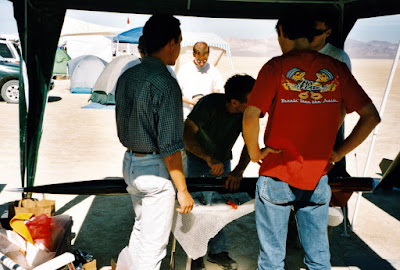
Top and second from top: in order to access and activate the BlackSky AltAcc recording accelerometers in the electronics bay on the erected rocket, we had to resort to driving one of our rental cars as closely as possible to the launch pad. This makeshift platform enabled Marco Schenker to turn on the electronics and confirm their operation. Dave Triano of Shadow Composites can be seen preparing the igniter (top photo, right).
Centre: with the rocket thus ready for launch, Dave inserts the igniter into the Aerotech N2000 motor.
The final photo shows a look back at the rocket waiting for the launch command on the pad, as our team receded to safety.
Labels:
4" aluminium/glass/carbon rocket
,
Aerotech
,
AltAcc
,
BALLS launch
,
Black Rock Desert
,
BlackSky
,
Dave Triano
,
Dr. Rocket
,
N Project
,
N2000
,
Shadow Composites
Wednesday, 17 August 2016
N Project: 4" Aluminium/Glass Fibre/Carbon Fibre Rocket, Part 6
Top photo shows team members Eugene Trubowitz, Dejan Romancuk, and Marco Schenker weighing the fully flight-ready 4" aluminium/glass fibre/carbon fibre rocket at the BALLS launch director's position. The rocket and its N2000 motor came in at 17.1 kilograms. This weight also included the ejection charges, recovery system, and altimeter batteries.
After the weight check, the submission of the required papers, and a visual inspection, we were cleared to take the rocket out to the launch pads. The bottom photo shows Dave Triano of Shadow Composites (second from right) assisting us in inserting the rocket into guide rail of the launch pad.
Monday, 25 July 2016
N Project: 4" Aluminium/Glass Fibre/Carbon Fibre Rocket, Part 5
Top: final pre-launch work at our BALLS X launch preparation area out on Black Rock dry lake, on Saturday, September 30, 2000. Marco Schenker (left), a friend from our teenage model rocket days, is holding the N2000 motor before insertion into the Dr. Rocket motor case which doubled as the lower airframe of the 4" aluminium/glass fibre/carbon fibre rocket.
Second photo from top: the author of this blog, inserting the greased N2000 motor while Marco Schenker is holding the motor case. Team member Erol Ünala (left) is filming the procedure.
Third photo from top: our esteemed friend and US partner Dave Triano of Shadow Composites (left) and project initiator Professor Eugene Trubowitz (second from left) are seen preparing to seal the motor case with the forward closure. Team members Marco Schenker and Erol Ünala are looking on.
Bottom: Eugene Trubowitz securing the upper airframe to the loaded lower airframe section. Team members Marcel Busse (left), Marco Schenker (right) and Dejan Romancuk (far right) are standing by to assist.
Second photo from the top by Zane Reed Johnson; all other photos by the author of this blog.
Sunday, 24 July 2016
N Project: 4" Aluminium/Glass Fibre/Carbon Fibre Rocket, Part 4
Top: the near completed 4" aluminium/glass fibre/carbon fibre N-motor rocket, photographed at the Swiss Federal Institute of Technology in Zurich, Switzerland, in late September of 2000, the week of the launch. The rocket was then placed and secured in a flight case, together with its 4" glass fibre/carbon fibre sister ship, and flown to Reno, Nevada. After spending a couple of day purchasing additional tools and supplies in Reno, we transferred the rockets and support equipment into cars and, on September 29, 2000, proceeded to Gerlach, Nevada, at the edge of the Black Rock desert/dry lake.
Centre: securing the attachments of the recovery system before installing the BlackSky AltAcc recording accelerometers at one of our rooms at the generously named Bruno's Country Club in Gerlach, September 29, 2000.
Bottom: the Aerotech N2000 motor before installation in the motor case, photographed at our BALLS X launch preparation area out on the dry lake, on Saturday, September 30, 2000.
Sunday, 17 July 2016
N Project: 4" Aluminium/Glass Fibre/Carbon Fibre Rocket, Part 3
Detail work on the 4" aluminium/glass fibre/carbon fibre N-motor rocket, at the Federal Institute of Technology in Zurich, Switzerland, in September of 2000. Following the application of black and red paint to the rocket at an automotive paint shop, we began assembling the electronics compartment. The main mounting base for the electronics consisted of an aluminium centering ring and shoulder, screwed to the modified and threaded forward closure of the aluminium N2000 motor case. This construction also served at the mounting point for the glass upper airframe section.
The second photo from the top shows Professor Eugene Trubowitz during a test assembly of the upper airframe section to the lower half of the rocket with the still empty electronics compartment. A piece of white insulation foam can be seen on the aluminium centering ring; this was designed to shield the electronics from the head emitted by the motor.
Threaded steel rods then served to hold four custom-made aluminium mounting bridges, to which we attached the two BlackSky AltAcc dual deployment recording accelerometers. The AltAccs were intended to trigger the release of the Rocketman main und drogue parachutes.
Moreover, the threaded steel rods also provided the mounting points for the sealable aluminium top bulkhead/shoulder, which, in turn, held the two pyrotechnic release modules and the aluminium recovery system strap retainer bars. The entire assembly was beautiful and tidy, but, in hindsight, perhaps a bit too delicate for the loads it would encounter.
Thursday, 7 July 2016
N Project: 4" Aluminium/Glass Fibre/Carbon Fibre Rocket, Part 2
Further images documenting the construction of the 4" aluminium/glass fibre/carbon fibre N-motor rocket for the BALLS 10 experimental launch at Black Rock Desert in Nevada. The photos were taken at the Swiss Federal Institute of Technology's machine shop in Zurich, in September of 2000.
Top photo shows the rear half of the rocket, essentially a Dr. Rocket 98 mm aluminium N motor case with welded aluminium fins. Aerodynamic fillets, consisting of a black epoxy mixture, have been applied over the weld lines.
Second photo from the top shows the project's initiator, Swiss Federal Institute of Technology Professor Eugene Trubowitz, concurrently preparing the two 4" rockets of the project for the installation of the rail guides and their aluminum stand-offs. The epoxy fillets on the 4" aluminium/glass fibre/carbon fibre rocket in the foreground have in the meantime been sanded to the final configuration.
Third image depicts the custom-made aluminium centering ring and shoulder, mounting point for the glass fibre upper airframe section, screwed to the modified and threaded forward closure of the motor case.
Bottom image was taken during the first tentative assembly of the still unfinished and unpainted rocket at the Federal Institute of Technology, in mid-September 2000. The glass fibre upper airframe section has been crowned with the custom-made carbon fibre/steel nose cone. The rocket stood 2336 mm tall.
Saturday, 25 June 2016
N Project: 4" Aluminium/Glass Fibre/Carbon Fibre Rocket, Part 1
Construction of the 4" aluminium/glass fibre/carbon fibre N-motor rocket, one of three flight vehicle designs built by our team for the BALLS 10 experimental launch held at Black Rock Desert in Nevada, in 2000. The rockets were designed by the project's initiator, Swiss Federal Institute of Technology Professor Eugene Trubowitz, who subsequently invited me to be a main partner in logistics, financing, construction, and launch.
The 4" aluminium/glass fibre/carbon fibre rocket consisted of a Dr. Rocket 98 mm aluminium N motor case doubling as a load bearing airframe structure, and an upper airframe section of the same diameter, made from glass fibre. The custom-made nose cone was manufactured from carbon fibre and steel.
The rocket's three Anticorodal-110 T6 aluminium fins were welded directly to the motor case. They measured 317.5 mm by 114.3 mm, at a strength of 4 mm. We initially contracted the welding to the renown Pilatus aircraft factory in central Switzerland. The results were startlingly disappointing, however. While the welds were of a clean external appearance (top photo), Pilatus had actually welded right through the motor case, thus rendering the entire component unusable. We were suitably surprised; this was a reputed aircraft factory, and they had promised us an expert job.
As we were working on three different rockets at the same time and thus were subjected to a tight schedule until the launch date at the end of September 2000, we purchased another motor case and had Dr. Rocket courier it immediately across the Atlantic. This time, we contracted the welding of a new set of fins to E. Nussbaumer AG, an aluminium welding shop in Bremgarten, a small town in the Swiss countryside. The second photo from the top shows Professor Trubowitz (far right) explaining the work to be done to an employee of E. Nussbaumer AG, using the damaged motor case as an example. Nussbaumer's welding was fantastic, and we were finally able to proceed with the remaining construction of the rocket.
The lower two photos show the thus completed tail section of the rocket at the Swiss Federal Institute of Technology's machine shop. Fins and motor case have been masked, leaving only the welds exposed, in anticipation of the application of an aerodynamic fillet consisting of an epoxy mixture. The second photo from the bottom shows the tail section of another one of the project's three rockets in the background, the 4" glass fibre/carbon fibre vehicle.
Saturday, 14 May 2016
N Project: 6" Glass Fibre/Carbon Fibre Rocket, Part 2
Further images illustrating the construction of the 6" glass fibre/carbon fibre N-motor rocket designed for the BALLS 10 experimental launch at Black Rock Desert in Nevada, in 2000.
Top photo shows Professor Trubowitz test-fitting an aft metal flange to the 98 mm Dr. Rocket N2000 aluminium motor case at what was then the Leonhardstrasse machine shop of the Swiss Federal Institute of Technology in Zurich, Switzerland, in September 2000.
Lower two photos show the main carbon and glass fibre components of the rocket laid out after the installation of the fin unit and before cutting the upper airframe section to length.
Sunday, 17 April 2016
Black Rock Desert N Project
The three rockets of the N project, photographed at what was then the Leonhardstrasse 21 machine shop of the Swiss Federal Institute of Technology, Zurich, in September 2000. From left: 4" aluminium/glass fibre/carbon fibre rocket, 4" glass fibre/carbon fibre rocket, and, behind it, 6" glass fibre/carbon fibre rocket. All three rockets were designed to be powered by Aerotech N2000 composite motors in Dr. Rocket 98 mm aluminium motor cases.
The N project was conceived by Professor of mathematics Eugene Trubowitz, who generously invited me to be a main partner in this extraordinary endeavour. We were supported by a fantastic team of friends as well as Federal Institute of Technology students. Two of the rockets were eventually launched during the BALLS 10 launch at Black Rock Desert in Nevada, USA, in September and October of 2000.
Subscribe to:
Posts
(
Atom
)