Showing posts with label Mantis launch pad. Show all posts

Sunday, 9 October 2016

Vehicle 77 Redux


A clear personal favourite in my fleet, the Enerjet Nike Ram-inspired Vehicle 77, photographed in northeast Switzerland on July 30, 1999, on the occasion of a flight powered by a 24 mm Aerotech E28-7T RMS composite motor. This flight took place in the early afternoon of a beautifully clear day, with low winds, and a temperature of around 30 degrees Celsius.

Launched off an Aerotech Mantis pad, Vehicle 77 carried a 6 volt piezo sonic locator. The rocket flew fast, very stable, and out of sight, to a computed altitude of slightly over 800 meters. The parachute deployed perfectly, but the rocket's payload section and parachute became entangled in a barn drain pipe upon landing. The tallest member of our little launch group was just able to pull it free, but the piezo sonic locator was lost during the retrieval, and the plastic parachute was damaged. Vehicle 77 itself survived in perfect condition.

A few weeks later, I replaced damaged parachute (it had likely been the wrong choice for such a rocket at any rate) with a nylon parachute by Rogue Aerospace.

Monday, 5 September 2016

Vehicle 75


Maiden flight of Vehicle 75, powered by an Aerotech E15-7W 24 mm composite motor, northeast Switzerland, July 30, 1999. The rocket was launched from an Aerotech Mantis launch pad and carried a custom 9 volt piezo sonic locator with a diameter of 31.5 mm. It was a delightfully flawless and high flight.

Vehicle 75 is purely a sport model; it measures 670 mm in length and 42 mm in diameter, weighing 124 grams. The airframe was constructed with Estes components, and it utilizes plywood through-the-wall fins. Vehicle 75 is designed to fly with D to F motors and is recovered with a nylon parachute.

Bottom photo shows Vehicle 75 in Zurich, Switzerland, in May of 2016.

Thursday, 28 July 2016

Vehicle 9


First flight of Vehicle 9 on a conservative Estes D12-5 black powder motor, launched from an Aerotech Mantis launch pad, northeast Switzerland, May 28, 1999. This was a perfect flight to a Rocksim-computed altitude of approximately 380 meters. Due to wind drift, the rocket was initially lost after parachute deployment. Fortunately, we found it later that day, by chance.

The unashamedly Estes Astron Goblin inspired Vehicle 9 has a length of 414 mm and a diameter of 42 mm, with 2.5 mm balsa wood fins. It was built from Estes parts and is intended for 24 mm D and E motors.

Top photo taken by Erol Ünala; lower photo shows Vehicle 9 in Zurich, Switzerland, on June 7, 2016.

Wednesday, 27 July 2016

Vehicle 39


The very first rocket ever featured in this blog, Vehicle 39 A Enigma, photographed on the occasion of a return to the location of its first flight in northeast Switzerland, on June 17, 1999, 13 years after the event.

Vehicle 39 was launched on an Aerotech E15-7W composite motor, from an Aerotech Mantis launch pad. The Mantis had originally been developed by Enertek, a company established in the late 1980s by Centuri's Lee Piester, together with Gary Rosenfield, Bill Stine, and Paul Hans. Unfortunately, Enertek failed to get off the ground, so to speak, and this truly versatile launch pad design (along with other items) later resurfaced a an Aerotech product. As with all of my launch pads, I added a slanted umbilical mast to my Mantis, in order to attach the ignition wires and thus reduce the weight which often threatens to pull the ignitor out of the motor.

Vehicle 39's flight was perfect, as was the deployment of the booster and payload section parachutes. The rocket carried two Estes Transroc II sonic beacons.

Photography by Erol Ünala.

Thursday, 21 July 2016

Vaughn Brothers Rocketry EX-18


Vaughn Brothers EX-18 two-stage minimum-diameter model rocket (intended for 18 mm motors), photographed on an Aerotech Mantis launch pad in Thalwil, Switzerland, in May of 1999.

The EX-18's high-performance design was vaguely reminiscent of Centuri's equally striking two-stage Stiletto model rocket, but the Vaughn Brothers kit was rather more basic in its contents (evident already by the plain face card), in spite of containing advanced materials in the shape of glass fibre fins and Kevlar shock cord. The result was a beautifully immaculate, robust rocket, however.

Vaughn Brothers RK-019 EX-18 face card © by Vaughn Brothers Rocketry , scanned from my actual kit.

Wednesday, 13 July 2016

Vehicle 69 With Estes AstroCam 110


Photo flights using Vehicle 69 with a standard Estes AstroCam 110 forward-looking aerial camera, northeast Switzerland, June 17, 1999. The rocket was flown three times that day; all flights were flawless and stable and returned one analogue photo each. In addition to the camera, the payload also included an Estes Transroc II sonic beacon to facilitate locating the rocket after landing.

The launches were conducted from one of the formidable Aerotech Mantis launch pads. The first flight utilized an Aerotech E15-7W single-use composite motor, the second was conducted with an Estes D12-7 black-powder motor. Vehicle 69's final photo flight of the day made use of an Aerotech D13-7W RMS reloadable composite motor. The rocket was initially lost upon recovery; we only managed to find it after a lengthy search.

The red hue visible on the right in the aerial shot is an old school analogue photo development artefact. Top photo shows Vehicle 69 in Thalwil, Switzerland, on June 8, 1999.

Wednesday, 1 June 2016

Vehicle 66


Maiden flight of the then newly completed Vehicle 66 on a somewhat conservative Estes D12-7 black powder motor, launched from an Aerotech Mantis launch pad, northeast Switzerland, June 17, 1999. Vehicle 66 was designed as a pure sport model, strongly inspired by the legendary Estes Der Red Max, a model rocket I worshipped as a teenager in the late 1970s after building it both in its original guise and in the Der Big Red Max version.

Vehicle 66 measures 390 mm in length and 44.5 mm in diameter. It was built from MRC and Estes parts and carried an Estes Transroc II sonic beacon during its first flight. The rocket is intended to be flown with D, E, or F motors. Top photo was taken in Zurich, Switzerland, on May 18, 2016.

Tuesday, 3 May 2016

Enerjet Nike Ram Copy


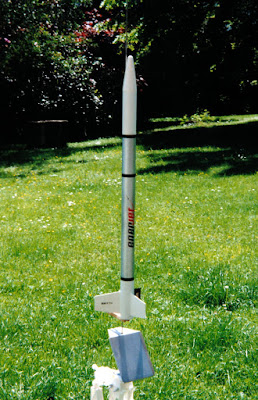
Vehicle 77, a sport model rocket with payload section, loosely based on Enerjet's iconic Nike Ram advanced model rocket of 1972. Vehicle 77 measured 643 mm in length (versus the Nike Ram's 590 mm) and 34 mm in diameter (as per the original). It was designed to be powered by D or E-type composite motors and was constructed slightly more robustly than the original.

Vehicle 77 is shown here on an Aerotech Mantis launch pad. The photo was taken in Thalwil, Switzerland, in May 1999, the month of its completion. Vehicle 77 first flew on June 17, 1999, with an Aerotech E15-7W motor.

Thursday, 21 April 2016

Vehicle 70 Before Launch


Vehicle 70 Dominator, a sport payload model loosely inspired by Centuri's X-16 model rocket as featured in the company's Power System Handbook of 1979. The rocket had a diameter of 41.5 mm and measured 605 mm in length, and it was built using Estes and Centuri parts.

Vehicle 70 was designed to be flown using D to F-type motors and is pictured here on an Aerotech Mantis launch pad, before its maiden flight with an Estes D12-5 black powder motor. The rocket carried an Estes Transroc II sonic beacon. Northern Switzerland, June 17, 1999.